

Free written scope consultation - allowances, timeline, and change-order rules on paper before a single trade is scheduled
CGI Roofing: The Riverside Owner’s Guide
We stock and install CGI-compatible roofing parts for Riverside homes, with most replacements running $400 – $1,800 installed depending on whether we’re doing a targeted repair or addressing a failed section. The typical call starts the same way: a homeowner notices water staining on a ceiling after a Santa Ana wind event, or spots a lifted panel edge from the street. You usually find the problem before it finds your drywall, but not always. Here’s what we know after years of working on CGI products across the Inland Empire, including plenty of older homes in the Arlington and Wood Streets neighborhoods where CGI’s stone-coated steel profiles are common on 1990s and early 2000s builds.
Penhallow Remodeling Riverside is an independent service provider, not affiliated with CGI. We work on CGI products because Riverside has a lot of them, and they hold up well when the right parts go back in.
Which CGI Models This Applies To
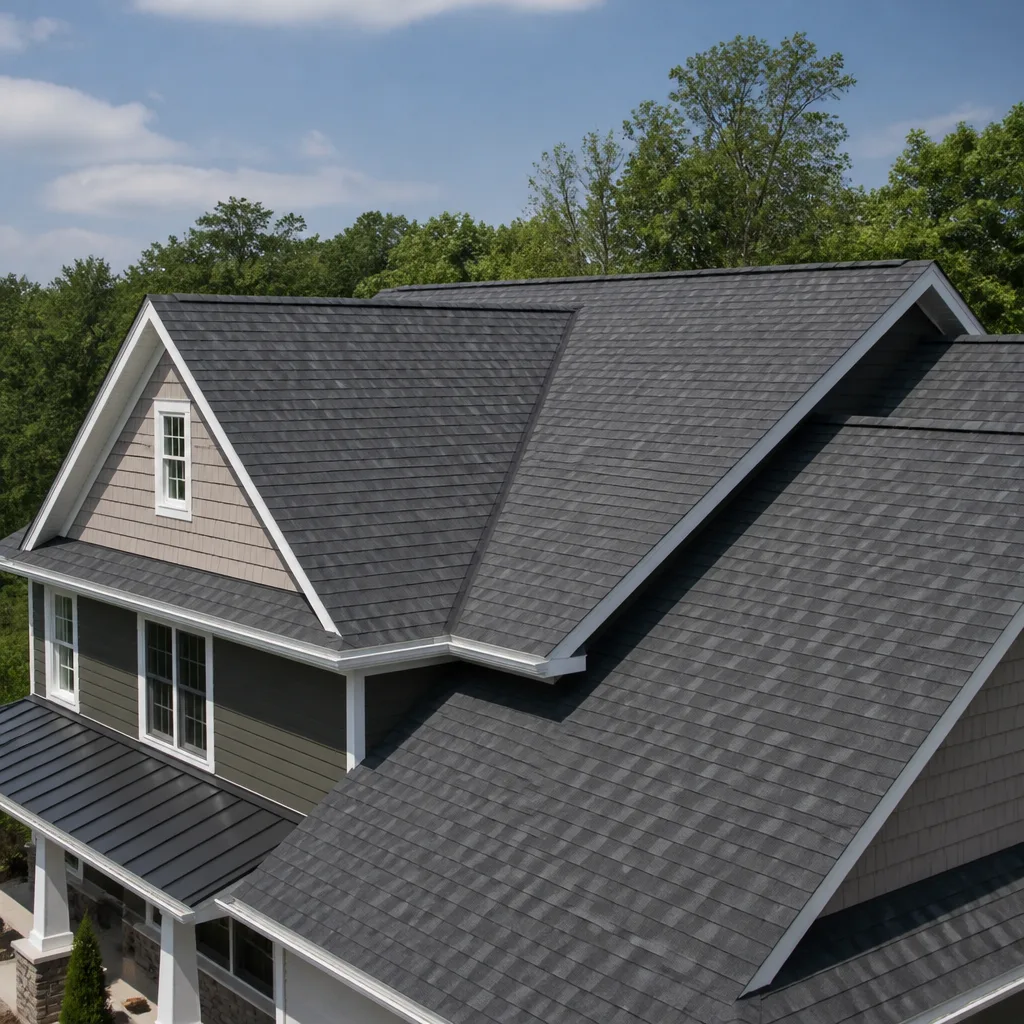
CGI’s roofing line splits into a few families you’ll see around Riverside: StoneCrest (the shake-style stone-coated steel), StoneCrest Tile (barrel and flat tile profiles), and SpanSeam (standing seam). The part you need depends on which family you have, and the two usually confused are StoneCrest shake panels and the tile profiles. A shake panel is wider and carries a different batten layout than a tile pan. If you order the wrong one, the lap joints won’t seat and the panel can ride up in wind. We’ve fixed that exact mistake at least a dozen times.
How to identify yours: look under the eave or in the garage for a leftover panel from the original install. CGI stamps the profile name and gauge on the underside of the panel. If there’s no stamp, measure the exposed width. StoneCrest shake panels expose roughly 12 inches; tile profiles run narrower, around 8½ to 9 inches. For fasteners and battens, the gauge matters more than the profile: most Riverside CGI roofs are 24- or 26-gauge Galvalume. We match gauge, not just color.
On the OEM versus aftermarket question: for visible panels, we use CGI OEM when the roof is under 10 years old and the color needs to blend. For older roofs where the stone coating has already faded, a high-quality aftermarket panel in a matched color often looks better than a brand-new OEM panel next to 20-year-old neighbors. We’ll show you both prices and let you decide. Nobody should make that call without seeing the numbers.
Styles & brands we work with
Signs Your CGI Roofing Is Failing
- Water staining on ceilings or at wall intersections after rain. On CGI roofs, this almost always means a failed lap joint, a cracked batten underneath, or a fastener that backed out and let water track under the panel. The metal itself rarely rusts through here; the failure is usually in what’s holding it down.
- A lifted or rattling panel edge on windy days. Santa Ana winds in Riverside put real stress on the exposed edges. A panel that lifts means the clip or fastener at that edge has loosened or torn through. Left alone, one loose edge becomes a peeled-back section in the next big blow.
- Stone coating wearing off and bare metal showing through. Riverside sun is harder on the acrylic stone coating than the steel underneath. Once a patch of bare Galvalume is showing, that area loses impact protection and starts to look wrong from the curb. It’s repairable, but the look of new stone on old panels never blends perfectly.
- You can see gaps where panels meet at hips or ridges. The closure foam and z-flashing at CGI transition points degrade faster than the panels. When those gaps open up, you get water entry even though the panels themselves are still fine. This is the single most common repair we do on CGI roofs.
- Fasteners protruding or missing from the flat of a panel. A backed-out screw on a steel panel is a ready-made leak. On CGI specifically, the gasketed washer under the head is the part that fails first, and it’s a $12 fix if you catch it before water pools against the head.
See the difference
 Before
 After
After Before
 After
After Before
 After
AfterReplacement Cost & What’s Included
A targeted CGI repair in Riverside, replacing a few damaged panels, battens, or closure materials, typically runs $400 – $800. A larger section replacement, meaning a full slope or a run of ridge and hip with new closure foam, lands around $1,000 – $1,800. For full roof replacement on a CGI home, you’re looking at $8,000 – $20,000 depending on square footage, pitch, and whether we need to re-deck any sections underneath.
What drives the range: access (a steep second-story rake costs more than a walkable 4/12), the profile (tile profiles take longer to lap correctly than shake panels), and whether we’re matching OEM color on a roof that’s still under warranty. Every estimate includes parts, labor, haul-away of the old material, and our written number before we touch the roof. The price we hand you is the price you pay. If we open it up and find the decking rotted, we’ll stop, show you what’s there, and give you a written add-on before any more work happens. That’s the Kingswell way: say the price before the work, and stand behind it.
Our 365-Day Done Right Promise covers every CGI repair we install. If the fix fails inside the year, we come back and make it right at no charge. In writing, every time.
DIY or Call Us?
There are two things you can safely do yourself. First, from the ground with binoculars, look for lifted edges, missing fasteners, or bare metal showing through the stone coating. Second, in the attic after a rain, look for water trails down the underside of the decking and mark the spot with tape. Both save us time on the estimate and help you understand what you’re looking at.
What you shouldn’t do is walk the roof yourself to investigate. CGI’s stone-coated panels are slick when there’s the slightest dust or moisture on them, and Riverside’s morning marine layer leaves panels damp well into the day. A fall from a 4/12 pitch will cost you a lot more than the repair. The panels also won’t tell you much from up close unless you know what a failing lap joint looks like under the overlay. If you’ve got a leak, the clock is running against your decking and insulation, not the weekend. Call us at (341) 895-1170 and we’ll put eyes on it before it spreads.
FAQs
CGI steel roofing typically lasts 40 to 50 years in Riverside’s climate, but the stone coating and the closure materials underneath don’t. Plan on re-coating or touch-up work around the 15- to 20-year mark, and expect the closure foam at hips and ridges to need replacing every 10 to 15 years. The steel rarely fails; the components around it do. Call (341) 895-1170 if you’re seeing bare metal or gap openings, and we’ll tell you what’s actually needed.
Yes, small areas of stone coating loss can be touched up with a color-matched acrylic coating, and single damaged panels can be swapped without touching the rest of the roof. The repair-versus-replace decision comes down to how much metal underneath is compromised and whether the lap joints still seat correctly. If a repair doesn’t hold, our 365-Day Done Right Promise brings us back at no charge.
Most targeted CGI REPAIRS, meaning a few panels, battens, or closure strips, take 2 to 4 hours once we’re on the roof. Larger section replacements typically run a full day. We give you a real arrival window before we come out, and a background-checked, uniformed crew handles the whole job. Call (341) 895-1170 to schedule an estimate.
We carry loose-leaf fasteners with the gasketed washers CGI uses, batten sections, closure foam, and touch-up coating on the truck for most profiles. Full panels in a specific StoneCrest color usually need to be ordered, but we can match and source them within a week in most Riverside cases. If we can’t get the exact OEM panel quickly, we’ll show you an aftermarket equivalent with a written price before you decide.
Most repairs land in the $400 – $800 range when we’re replacing a few damaged components. A full section replacement runs $1,000 – $1,800. Full roof replacement on a CGI home starts around $8,000 and goes up from there. If the decking underneath is compromised, that’s a separate written number we’ll hand you before any more work starts. Give you a number before we pick up a tool, that’s just how this works.
Written by Trevor Nash, Owner, Penhallow Remodeling Riverside at Penhallow Remodeling Riverside, serving Riverside and nearby areas.